
Following Advance CTE’s release of the updated National Career Clusters® Framework, the MBA Research National Business Administration Standards have undergone strategic revisions to align with this new model. This modernization seeks to break down silos across various industries and in education, which have historically limited learners’ flexibility.
This alignment gives educators and states a seamless bridge between national standards and your classroom.
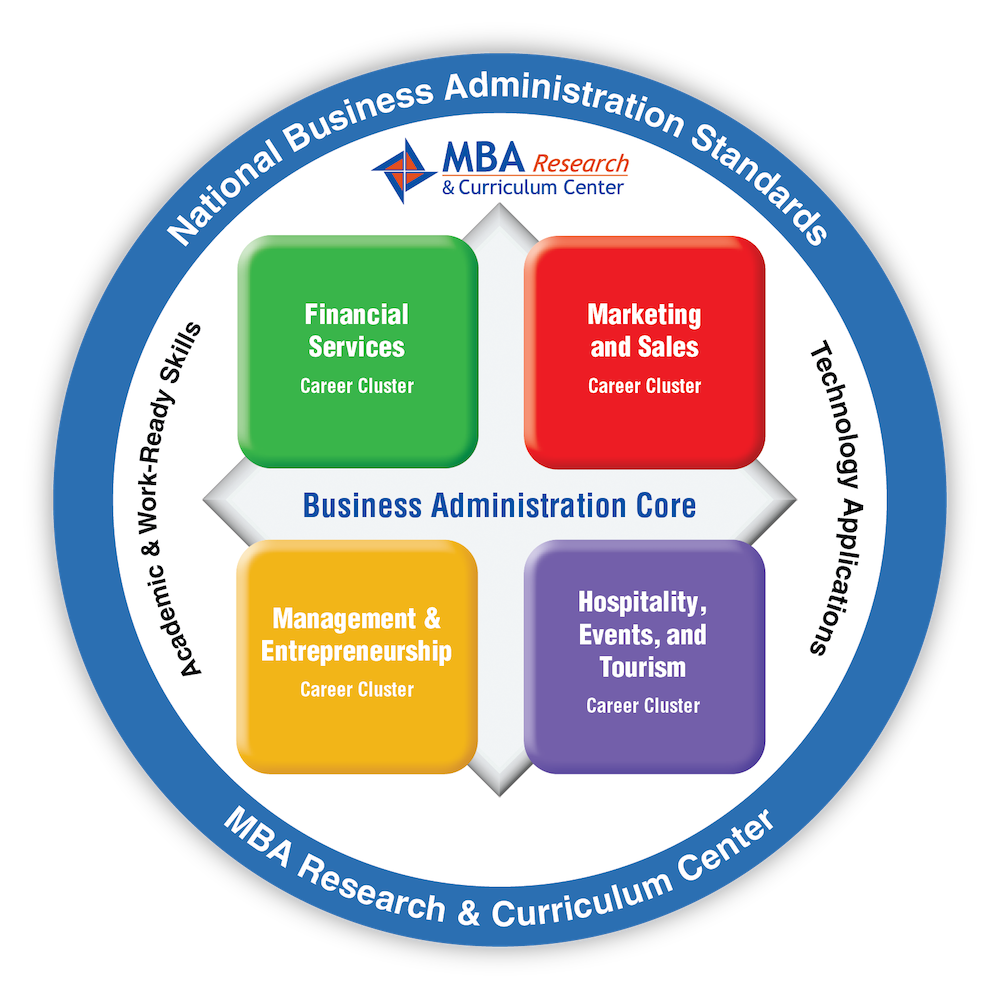
Our research incorporates both primary and secondary research, drawing on business sources rather than educational sources. Business-based research helps identify the current skills and knowledge employees need in the workplace. We focus our curriculum, instructional materials design, and assessment activities on four business-related clusters:
• Management and Entrepreneurship
• Financial Services
• Marketing and Sales
• Hospitality, Events, and Tourism (coming soon!)
The National Framework introduces the concept of “Cross-Cutting Clusters.” Unlike traditional clusters tied to a specific industry, these cross-cutting areas represent foundational, adaptable skills that power all sectors, from healthcare to agriculture to trades and technology and manufacturing.
These cross-cutting clusters are Management and Entrepreneurship, Marketing and Sales, and Digital Technology.
Many states are embracing this modernized framework, with some exploring ways to integrate business skills into existing pathways. They realize that specific skills and knowledge within these clusters benefit students regardless of their program of study and career objective.
Are you looking for a specific sub-cluster? Or are you building a foundational course? We’ve done the work for you!
Course guides are comprehensive roadmaps that provide a variety of educational materials, including performance indicators, ethical case studies, and activities for each course. Each course guide is aligned with the National Business Administration Standards.

Through our research, we have learned the importance of equipping students with the skills and knowledge needed for any career in business. The standards within the Business Administration Core apply to all career clusters in business. Our standards are organized on the premise of starting broad and narrowing in specificity as the student progresses in their program of study. This ensures that students enter the workforce, college, or a career with an understanding of these core concepts.
Our research efforts resulted in the identification of similar, overlapping skills and knowledge across the four clusters (Management & Entrepreneurship, Marketing & Sales, Financial Services, and Hospitality, Events, & Tourism).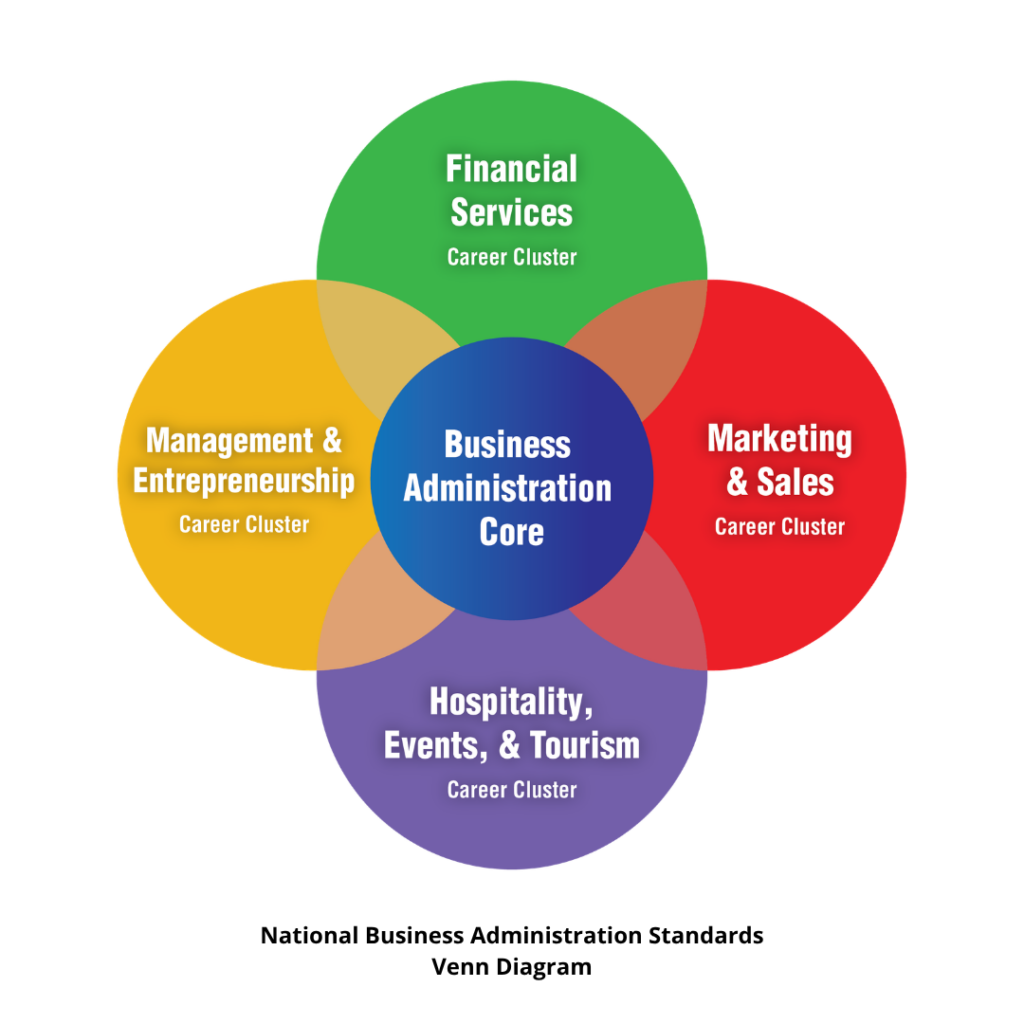
This common know-how is the Business Administration Core, composed of the following topics:
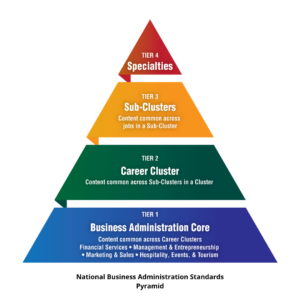
Each of the four Career Clusters contains content that is common to its Sub-Clusters. Each Cluster has four to five Sub-Clusters, and each Sub-Cluster contains content common to the jobs in it. Finally, content specific to a job or product is known as Specialties.
Instruction should be designed to move from general to specific, setting up the high school curriculum around the content in the Business Administration Core and a Career Cluster.
As students progress in their education, they should acquire content increasingly more specific to their area of interest in business.
The content within each of the four clusters is organized into Standards, Performance Elements, Performance Indicators, and Objectives.
Standards identify what students should know and be able to do as a result of instruction in any of the business-related clusters. These statements encapsulate the overarching intent/purpose of a work function.
The Economics Standard identified in the Business Administration Core, for example, is: “Understands the economic principles and concepts fundamental to business operations.” Each Standard/Instructional Area represents a particular topic—not a course.
Each Standard is composed of multiple Performance Elements. These statements are broad-based work or cognitive performances that aid in defining the Standards.
A Performance Element from the Economics Instructional Area, for instance, is “Understand the nature of business to show its contributions to society.”
Performance Elements are defined through Performance Indicators that are specific work-based actions—either knowledge or skills. They specify what an individual worker must know or be able to do to achieve the Performance Elements. These learning outcomes are measurable (i.e., can be assessed).
For example, one of the eight Performance Indicators for the Economics Performance Element “Understand the nature of business to show its contributions to society” is: “EC:070 Explain the role of business in society.”
Each of the Performance Indicators is further defined through a series of Objectives. This organizational component specifies the scope of each Performance Indicator. Their use tells teachers what content to include or exclude from their instruction.
For example, the Performance Indicator “Describe the concepts of economics and economic activities” is defined through Objectives as follows:
a. Define the following terms: economics, scarcity, economizing, opportunity cost, trade-offs, consumption, consumer, production, producer, exchange, and distribution.
b. Explain why wants are considered unlimited.
c. Discuss why scarcity exists.
d. Describe the three economic questions that all societies must answer.
e. Explain the importance of decision making in economics.
f. Describe four economic activities.
g. Discuss three factors that affect the value of money payments in a market economy.
MBA Research’s philosophy is that curriculum should be organized from simple to complex, thereby enabling students to acquire foundational understanding and skill before they acquire more advanced skills.
Each Performance Indicator is assigned to a curriculum-planning level based on the job level at which it is first needed within businesses. These curriculum-planning levels progress from simple to complex:
Looking for a high-level overview? Standards Executive Summary (1 pg)
Interested in a deeper dive into the Research? Standards Introduction (5 pg)
Want to learn our terminology? Standards Glossary (1 pg)
Learn more about the National Business Administration Standards by getting in touch with our team today.